
Fair Tipping for Back-of-House Staff

 Maya Patel
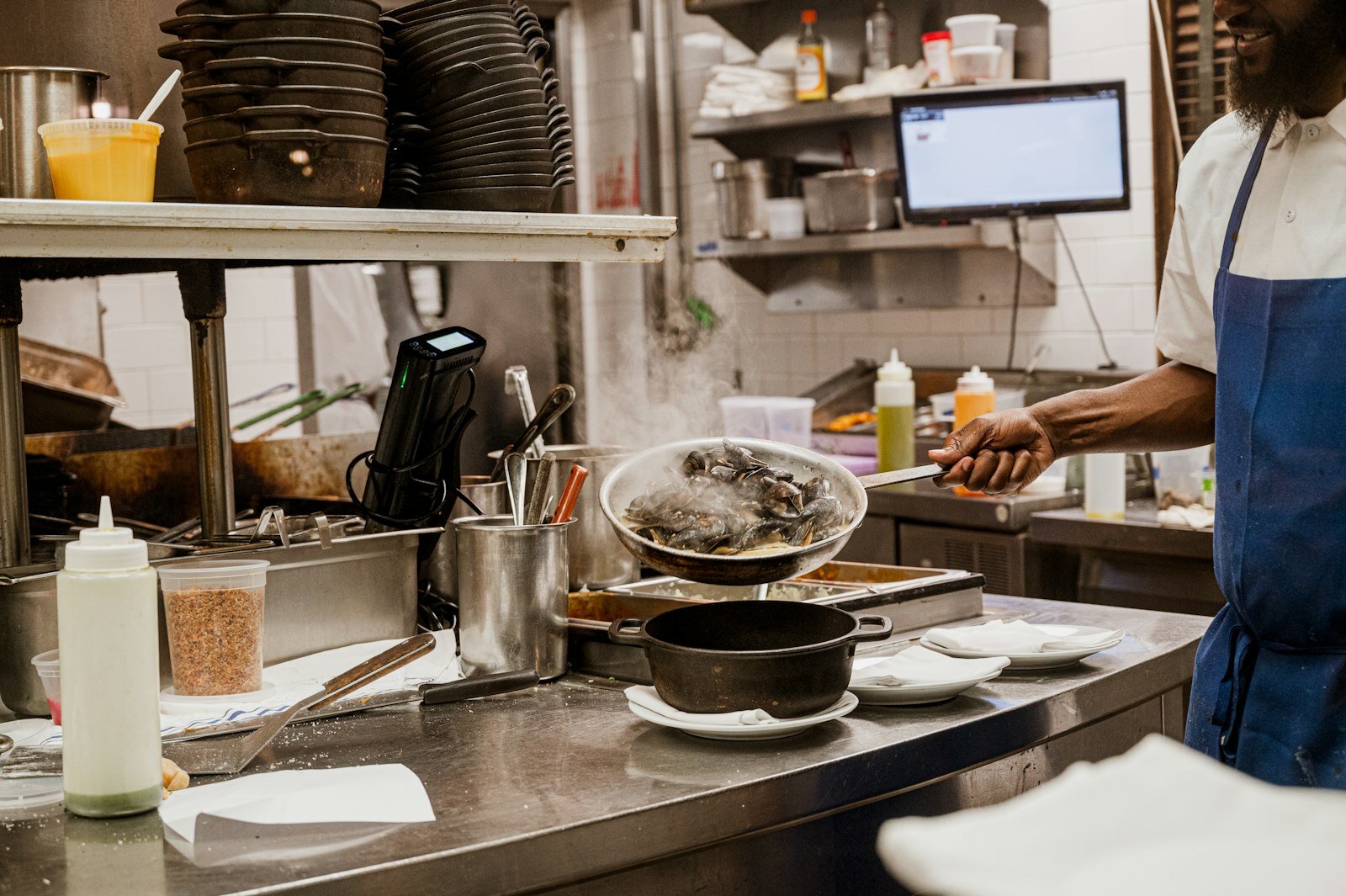
The people who cook your food, plate it under the pass, scrub the pots at midnight, and prep the mise en place for the following day's service are, by design, invisible to the diner. Hospitality's front-of-house and back-of-house divide is structural and deep: service staff inhabit a world of social performance and direct guest interaction; kitchen staff inhabit a world of physical labour, heat, precision, and hierarchy. Tips, which flow naturally to those who interact with customers, have historically been concentrated at the front of house — leaving the kitchen team excluded from the income supplement that makes hospitality wages tolerable.
This is not simply a matter of custom. It reflects the mechanics of cash tipping: money left on the table goes to the server, not the cook. Even where restaurants operate tronc systems to distribute tips, back-of-house inclusion has been inconsistent, contested, and opaque. The Employment (Allocation of Tips) Act 2023 has shifted the legal ground significantly — and understanding what it requires, and what it enables, is now essential for any hospitality operator serious about treating its people fairly.
What the 2023 Tips Act Requires
The Employment (Allocation of Tips) Act 2023 came into force in October 2024. Its core requirements are straightforward: employers must pass all tips, gratuities, and service charges to workers, without deduction; they must have a written tips policy; and that policy must be available to all workers. The Act explicitly prohibits employers from using tips to make up wages to the National Minimum Wage or National Living Wage — tips must sit on top of contractual wages, not substitute for them.
Crucially for back-of-house staff, the Act applies to all workers — not just front-of-house employees. Restaurants that previously directed all tips to servers and excluded kitchen staff are no longer on sound legal ground if they continue to do so without a written policy that explains the methodology. The Act does not prescribe a specific distribution formula — that remains the employer's decision — but it requires the formula to exist, to be documented, and to be communicated.
Designing a Fair Distribution Policy

The mos t contested question in tip distribution is the appropriate share for back-of-house staff relative to front-of-house. There is no legally mandated formula, and practices vary widely across the industry. A fine dining restaurant where the kitchen's contribution to the experience is central — where guests are partly paying for the chef's vision — might reasonably weight kitchen staff more heavily than a casual dining venue where food is relatively standardised and service is the differentiating factor.
Common approaches include a fixed percentage of total tips directed to a kitchen pool (distributed equally among kitchen staff on the shift), a point-based system where different roles carry different weightings, or a straight-line distribution across all employees. Each approach has advantages and vulnerabilities. Fixed percentage pools are simple and predictable; point-based systems are more reflective of role contribution but require careful maintenance; straight-line distribution is maximally equal but may feel unfair to senior chefs whose skill anchors the kitchen's output.
What matters most, legally and ethically, is not the specific formula but the transparency around it. Workers who understand how tips are distributed — who know their share, can see the calculation, and trust the process — accept outcomes they might not personally prefer. Workers who receive unexplained amounts with no visibility into the methodology are far more likely to suspect unfairness, even when the actual distribution is reasonable.
Digital Tipping and Back-of-House Inclusion
Digital tipping platforms create infrastructure that makes back-of-house inclusion both more practical and more transparent. A crew tip page for "The Kitchen at [Restaurant Name]" — linked from a QR code on the menu or receipt — allows diners who specifically want to acknowledge the kitchen team to do so directly. The funds go to a crew pool that distributes to kitchen staff, without passing through front-of-house distribution at all.
This is a different model from the integrated service charge or tronc pool — it is opt-in, guest-directed, and visible. Some restaurants have found that naming the kitchen team — "Leave a tip for our chefs here" — generates genuine engagement from diners who appreciate knowing that their appreciation can reach the people who cooked the meal. It also reframes the kitchen team as a presence to be acknowledged, not simply infrastructure to be taken for granted.
For restaurants that operate a unified crew tip page — covering both front and back of house — the distribution logic built into the platform handles the allocation automatically according to the restaurant's configured formula. Workers in all roles receive their share on the same timeline, with the same visibility into what arrived and why. Platforms like Tippidy allow crew tip distributions to be configured in advance and adjusted as staffing changes, without requiring manual recalculation after every service.
The Kitchen Porter Problem
Kitchen porters occupy the lowest-paid and physically most demanding position in hospitality. They clean, lift, run, and endure conditions that most diners never consider while eating. They are also the workers least likely to be included in tip distribution schemes, even under progressive operators who include chefs. Yet kitchen porters' contribution to a smooth service is not optional: a kitchen running low on clean equipment, unable to plate correctly, or backed up on washing is a kitchen that cannot deliver food on time.
Including kitchen porters in tip distribution — even at a modest share — sends a meaningful signal about how a business values its workforce. For operators designing a distribution policy under the 2023 Act, the question of whether to include kitchen porters and at what level is worth deliberate consideration, not default exclusion. The amounts involved are not large — a small share of a typical evening's tips — but the signal to the worker and the team is disproportionate to the financial cost.
The Conversation That Needs to Happen
Fair tipping for back-of-house staff requires two conversations that the industry has historically avoided. The first is between operators and kitchen staff: what is the tips policy, how does it work, and how does each worker find out what they received? The second is between the industry and its guests: the people who cooked your meal deserve acknowledgement, and here is how you can provide it.
Neither conversation is comfortable. Kitchen culture has a stoicism about pay and conditions that makes advocacy feel out of character. Hospitality margins are tight enough that owners resist any obligation that feels like an additional cost. But the legal framework has changed, the tools to implement fair distribution transparently now exist, and the moral case has not been stronger. The kitchen team that sends out three hundred covers on a Saturday night without a single returned dish deserves to see the tips that night's service generated — and to see their share arrive promptly, clearly, and without having to ask.
Este artículo forma parte de nuestra guía completa sobre propinas digitales — aprende cómo recibir propinas con tarjeta, Apple Pay o Google Pay.
Comentarios (0)
Iniciar sesión para dejar un comentario.
Artículos relacionados


Empieza a recibir propinas digitales hoy
Crea tu página de propinas gratuita en Tippidy, añádela a Apple Wallet y Google Wallet, y deja que los clientes te dejen propina en segundos con Apple Pay, Google Pay o cualquier tarjeta — sin app, pagos instantáneos.
Compatible con Apple Wallet y Google Wallet · Sin cuotas mensuales