
Tipping for Tattoo Artists

 Maya Patel
A tattoo artist spends years developing a craft that is simultaneously technical, artistic, and deeply personal. They work on a living canvas, often creating something their client will carry for the rest of their life. The consultation alone — understanding what a client wants, translating an idea into a design that will work on skin, adjusting scale and placement — can take significant time before a needle is ever lifted. Yet for all this skill and intimacy, the conversation about tipping in tattooing is curiously awkward and inconsistent across the industry.
Some studios operate on strict day rates with no expectation of tips. Others — particularly in the United States, where the norm originated — treat tips as an integral part of the tattooist's income. In the UK, the picture is mixed: independent artists working out of private studios tend to rely more heavily on tips than those employed in high-volume street shops, and the move to cashless payments has changed the practical mechanics of how tips flow.
Why Tattooing Invites Tipping More Than Most Trades

Tat tooing shares characteristics with other tipped service professions — hairdressing, massage therapy, nail art — but amplifies them. The work is skilled, requiring years of apprenticeship and continuous refinement. It is irreversible, meaning the client places genuine trust in the artist's judgement. It is physically intimate, involving sustained close contact and often emotionally significant subject matter. And it is frequently customised: a custom design for a memorial piece, a portrait of a child, or a long-planned sleeve involves creative investment that goes well beyond the hourly rate.
These factors combine to create a service environment where tipping functions as a recognition of something beyond mere competency. Clients who receive a tattoo they love — that exceeded their expectations, that the artist clearly cared about — tend to want to express that in a way that the quoted price does not capture. The tip is the acknowledgement that this was more than a transaction.
Cash Was the Default — Until It Was Not
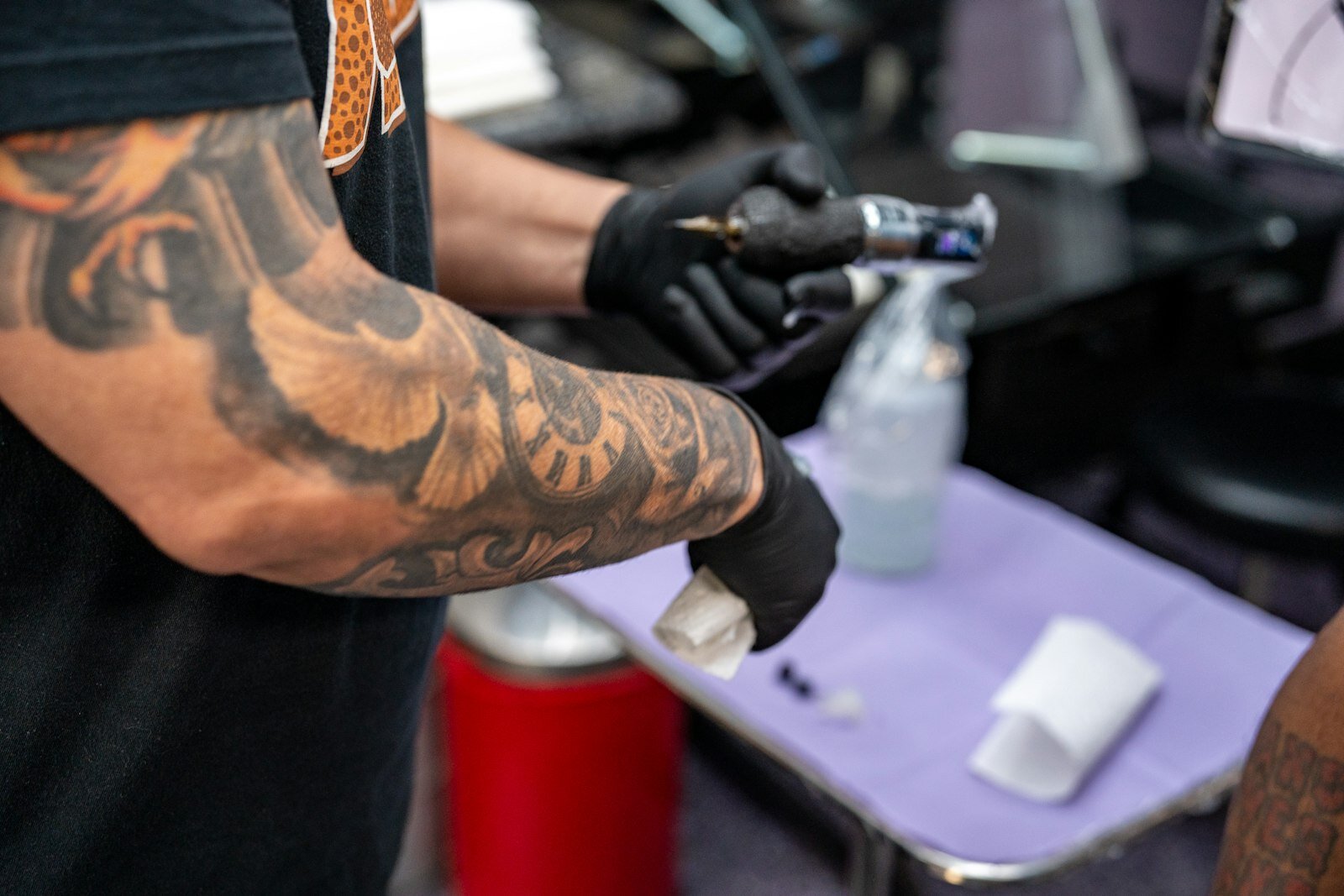
Historically, tattoo studios ran largely on cash. This was partly a cultural preference in an industry that valued informality, partly a practical convenience in studios where card terminals felt out of place, and partly a straightforward tax simplicity that everyone in the industry understood without discussing. Tips were notes handed over at the end of a session, often with genuine warmth, and went directly into the artist's pocket.
The shift to card payments and cashless operation — accelerated sharply by the pandemic, when cash handling became a concern — has changed this. Most tattoo studios now accept card payment as standard. But the informal cash tip that followed has not automatically transferred to a digital equivalent. Clients who would have peeled off a twenty at the end of a four-hour session now complete their card payment and leave, not because the impulse to tip has disappeared but because the mechanism has not been provided.
For artists working in studios where all payments go through the shop's terminal, this creates a double problem: the tip mechanism is missing, and any tip that does come through the POS system enters the studio's revenue before being distributed, introducing delay and uncertainty about how much will actually reach the artist.
Personal Tip Pages for Independent Artists
Independent tattoo artists — working from private studios, by-appointment-only spaces, or home setups — are well positioned to use personal digital tip pages. A QR code displayed at the consultation desk or at the point where the session concludes, combined with a brief natural mention ("If you want to leave a tip, here's the easiest way"), routes the gratuity directly to the artist's account without going through any intermediary.
The timing of the prompt matters. The moment a client first sees their completed tattoo, cleaned and wrapped — the moment of peak emotional response — is when the impulse to tip is strongest. Having the tip page accessible in that moment, rather than presenting it at checkout when the client is already mentally moved on, converts more of that impulse into action. Some artists include a small card with the aftercare instructions that also carries the QR code, serving both a practical and a tipping function in a single handout.
Employed Artists and Studio Distribution
Artists employed in or renting space in multi-artist studios face more complex terrain. Under the Employment (Allocation of Tips) Act 2023, tips paid to an employer — including those collected through a studio's POS system — must be passed on to workers in full, without employer deduction, and the distribution policy must be in writing. For booth-renters who are technically self-employed rather than employees, the legal picture is different, but the practical question of how tips are handled is equally important to clarify.
Studios that are transparent about their tip handling — who receives what, on what timeline, and through what mechanism — build better working relationships with their artists. Platforms that route tips directly to individual artists or crew accounts, bypassing the studio's financial infrastructure, are increasingly attractive to workers who want certainty that a grateful client's gesture arrives in full.
How Much to Tip — and When to Mention It
Clients who want to tip their tattooist but lack a frame of reference often default to rough service industry norms — ten to twenty percent — without accounting for the specific economics of tattooing. A longer session at a significant price point may warrant a tip at the lower end of the percentage range but still represent a substantial sum. A shorter, intricate piece by an artist who gave significant consultation time might warrant a more generous percentage in recognition of the uncaptured creative effort.
Artists who are comfortable mentioning their tip page do better than those who rely on clients to discover it independently. The mention does not need to be elaborate: "There's a QR code on the desk if you'd like to leave a tip — it comes straight to me" is straightforward and honest. Clients who intended to tip will appreciate the clarity; those who were not planning to tip are rarely alienated by a brief, natural mention.
The tipping conversation in tattooing is overdue for normalisation. The artists who create meaningful, permanent work on their clients' skin bring a combination of technical skill, artistic vision, and interpersonal sensitivity that deserves recognition beyond the agreed price. Making it easy for grateful clients to act on that recognition — with a tool that is instant, direct, and requires no cash — is a small but meaningful step towards the industry treating its own workers fairly.
Cet article fait partie de notre guide complet des pourboires numériques — apprenez à recevoir des pourboires par carte, Apple Pay ou Google Pay.
Commentaires (0)
Se connecter pour laisser un commentaire.
Articles connexes



Commencez à recevoir des pourboires numériques dès aujourd'hui
Créez votre page de pourboire Tippidy gratuite, ajoutez-la à Apple Wallet et Google Wallet, et laissez les clients vous laisser un pourboire en quelques secondes avec Apple Pay, Google Pay ou n'importe quelle carte — sans application, versements instantanés.
Compatible Apple Wallet & Google Wallet · Sans frais mensuels